About
Background and artistic practice
SHORT BIOGRAPHY
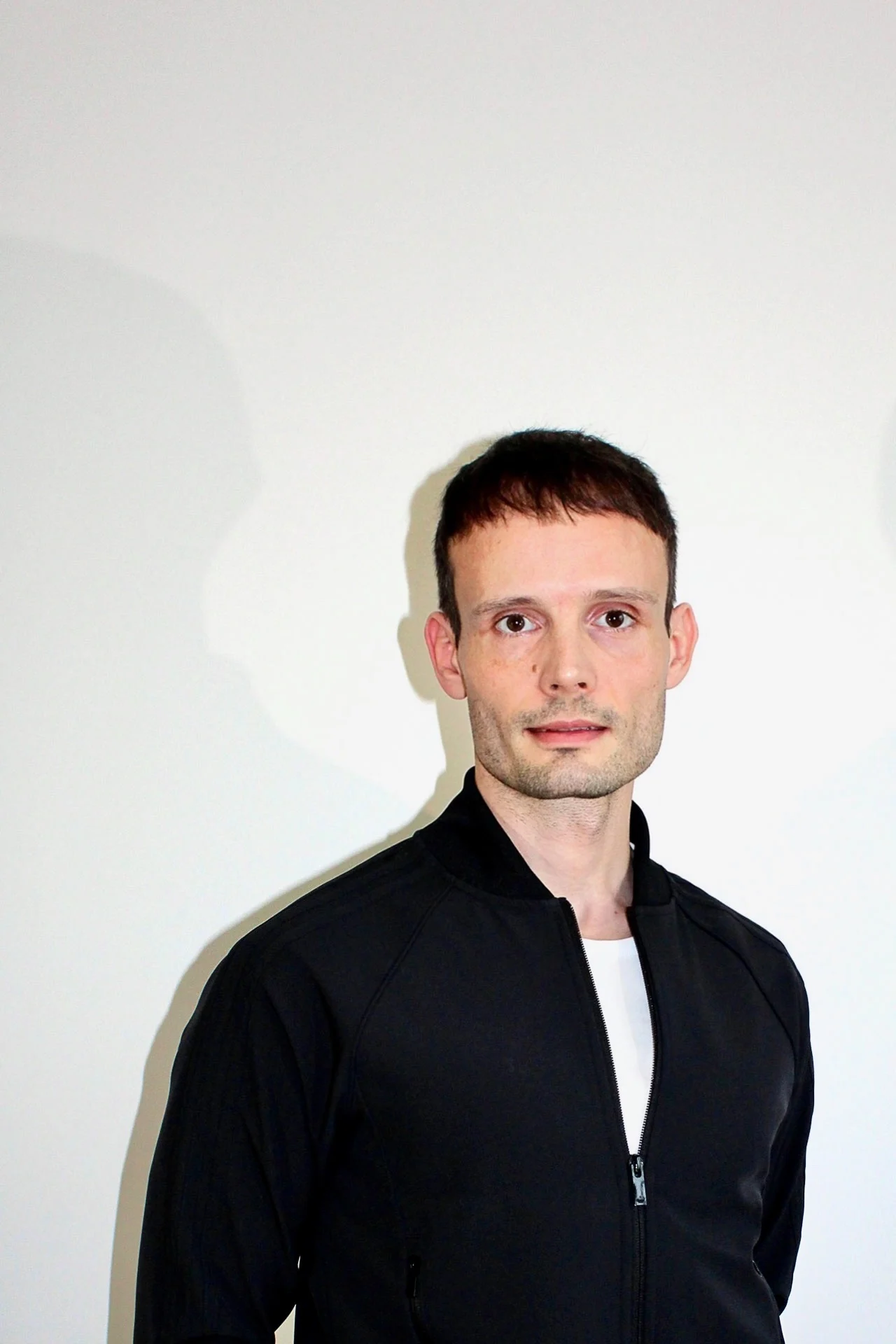
Tarik Goetzke (b. 1984, Berlin) is an artist and author. He creates audio works and installations for exhibitions, museums, and public space contexts.
His works are situated at the intersection of text, sound, and spatial situations and are often developed within the ongoing framework ME+, which he initiated in 2017 together with visual artist Anna Kubelík.
Goetzke’s work has been presented internationally in exhibitions, performances, and public institutions, including the Kunstgewerbemuseum Berlin, the Goethe-Institut China, and the Villa Massimo in Rome.
EXTENDED BIOGRAPHY
Read more
Tarik Goetzke was born in Berlin in 1984 and grew up in the eastern part of the city. The political, social, and urban transformations of the 1990s following German reunification form an important background to his early awareness of perspective, space, and societal change.
During his school years, Goetzke discovered theatre as a space for thinking and experimentation. His first practical experiences led him to P14, the youth theatre of the Volksbühne Berlin, where he worked as a director and author and assisted, among others, Dimiter Gotscheff. During this period, his interest gradually shifted from acting toward questions of how language, perspective, and perception are organised within performative structures.
Alongside his artistic practice, Goetzke studied philosophy and modern German literature in Berlin, as well as theatre directing at the University of Music and Performing Arts Frankfurt. Particularly formative were his engagements with philosophy of language, epistemological questions, and the analysis of dramatic structures, especially monological forms. He later deepened these investigations through studies in theatre, film, and media studies at Goethe University Frankfurt.
After directing several theatre productions in Frankfurt and Mannheim, Goetzke gradually shifted his practice from the theatre space toward exhibition and institutional contexts. Against this background, he developed the framework ME+ together with visual artist Anna Kubelík in 2017, which continues to serve as the point of departure for his installative works.
PRACTICE
The point of departure of the practice is self-authored texts that form the conceptual and narrative backbone of each work. On this basis, text-driven audio installations are developed for exhibitions, museums, and public space contexts.
These texts do not function as illustrations of images or spaces; rather, they unfold as independent narrative layers. Experienced through intimate, headphone-based listening situations, they enter into a precise dialogue with visual, spatial, or material conditions. Listening thus becomes a central mode of perception: a situated, temporal, and relational practice.
Within the ongoing framework ME+, text-based audio works are connected with different spatial, architectural, or institutional contexts. The works are conceived as open structures in which multiple perspectives coexist in parallel, without being merged into a single overarching narrative.
Goetzke’s practice operates between installation, sound art, and expanded narrative forms. At its core is listening as a mode of attention through which proximity, duration, and perspective become experientially tangible — and through which perception, responsibility, and meaning are continually re-situated.